| ADVOCACY AND ACTION
Call to Action
March 8, 2026 | Published by LWVAZ Advocacy Committee to update members on news and calls to action.
Editors: Gitelle Seer, Pinny Sheoran | Watch for our Call to Action emails, call the legislators on the committees with your concerns, and be sure to submit your comments on the RTS system. It’s essential that every Arizona citizen speak out against any bills that take away the power of your vote.
The link to all issues of “Call to Action” is posted on our website.
| |
CALENDARS
2026 Legislative Calendar
Mon. Jan. 12 2026 legislative session starts
Mon. Feb. 2 Last day for Senate introduction of bills
Mon. Feb. 9 Last day for House introduction of bills
Fri. Feb. 20 Last day for consideration of bills in the originating chamber
Crossover Week [Feb. 23 - Feb. 27]
Fri. March 27 Last day for consideration of bills in the other chamber
Fri. April 17 Last day for consideration of bills in Conference Committees
Sat. April 25 Adjournment Sine Die
| |
March 3- 11: Join League in Action here to participate in our call-in days on March 3 and 11, by calling your Senators to urge them to oppose the SAVE America Act.
March 28: LWVUS is joining No Kings as a national partner on Saturday, March 28.
|
Stay Engaged This Session
The legislative session is far from over—and neither is our advocacy. The bills listed below have advanced to the second chamber, which means they will be heard again, and your voice still matters. As these measures move through new committees and floor votes, we must continue to show up by submitting Request to Speak (RTS), tracking amendments, and urging lawmakers to either support or oppose these proposals.
Momentum can shift quickly in the second chamber. Testimony, public pressure, and timely action can make the difference between a bill moving forward, being amended, or stopping altogether. We encourage you to follow these bills closely, stay informed on upcoming hearings, and be ready to act when alerts go out.
What you can do now:
-
Monitor hearing schedules and agendas
-
Submit RTS to support or oppose at upcoming hearings
-
Share updates with your networks and encourage others to participate
Our collective engagement is critical at this stage of the process. Let’s keep the pressure on and make sure our priorities are represented every step of the way.
Read the LWVAZ Analysis of the bills that were heard in committees of the first chamber. https://docs.google.com/document/d/1S_jqtDezvGrEM-_A75VzLQbik1e9q8UdskCAhsk2Das/edit?usp=sharing
Status of bills:
HBs are House Bills, and SBs are Senate Bills. The following bills align with our advocacy priorities and are currently being monitored by our established issue teams.
The bills listed below have been passed from one chamber to the other and are now assigned to committees for hearings in the opposite chamber. They are organized below by League issue teams based on LWVAZ's top priorities. You can click on the links to review the bill.
| Legislative Calls to Action
RTS Now! | |
RTS Now!
Committee Hearings on Bills Week of March 9-13
Please use RTS (Request to Speak) to inform legislators if you support or oppose the bills listed below. You can also email the committee members and request your testimony and statements be entered into the public record.
League recommendations are based on research of the bills by the Legislative Analysis Issue Teams under the State Advocacy Committee. The issue teams’ reviews include analyzing the pros and cons, assessing the impact on diverse communities, and recommending support or opposition.
NOTE: RTS closes an hour before the hearing

| |
READ A DETAILED EXPLANATION OF WHY LWVAZ SUPPORTS OR OPPOSES THESE BILLS
Detailed Call to Action information on the bills being heard in committee March 9 to March 13, 2026, is available here: https://bit.ly/LWVAZCTA. Your input matters—don't wait to make a difference!
List of League’s legislative analysis for 2025 (PDF):https://www.lwvaz.org/docs.ashx?id=1597983
| REQUEST TO SPEAK (RTS): USE RTS TO INFLUENCE OUTCOME OF LEGISLATION | |
What is Request to Speak (RTS)?
Request to Speak (RTS) is an online, real-time system that allows the public to register opinions on bills being heard in committee. You can:
-
Indicate whether you are “for” or “against” the bill
-
Write a brief comment explaining your position
-
Register your willingness to speak (testify) during the committee hearing
We encourage you to use this powerful tool to make your voice heard at the legislature.
When Can I Use RTS?
You can only use RTS when a bill is being heard in committee and for a few days before the committee hearing. The legislative session starts the second Monday in January and lasts at least 100 days.
How Can I Learn More?
How do I get an RTS Account?
If you do not have an RTS account, please complete the Request to Speak Form, and a league volunteer will register your account at the Capitol. We will create your account with a generic password. Once you receive an email from us confirming that your account has been set up, we advise you to change your password immediately. Please note that you cannot register for RTS online.
|
Standing Up for Democracy: LWVAZ 2026 Legislative Week Highlights:
Another successful Legislative Week has wrapped up, highlighted by engaging Lunch & Learn sessions and more than 50 members participating in Legislative Lobby Day at the Capitol. Thank you to everyone who helped make the week such a success. We welcome your suggestions for topics and ideas for the 2027 Legislative Week. Please share your thoughts with us at lwvazadvocacy@gmail.com.
Lunch & Learn Series Highlights: Key Issues Shaping Arizona
LWVAZ hosted a lively series of informative and timely Lunch & Learn programs during the state league’s annual Legislative Lobby Week. These sessions brought together journalists, policy experts, educators, and election officials to explore key issues shaping Arizona’s civic landscape in an election year—from press freedom and voter engagement to education policy and how the legislative process really works.
The series kicked off on Sunday, Feb. 22, with “The First Amendment and Freedom of the Press,” a program focused on press freedom and the changing media environment, co-hosted with the League of Women Voters of Metro Phoenix. Panelists included Jordan Gerard (Arizona Capitol Times), Nicole Ludden (Arizona Agenda), Erin Coyle (ASU Cronkite School/ASU Law), Mary Jo Pitzl (freelance journalist), and Alyssa Horton (student journalist). They shared candid insights into the pressures facing modern journalism: economic instability, harassment and intimidation of reporters, and costly litigation that can create “chilling effects” on reporting. Speakers also discussed how the news landscape has become increasingly fragmented as audiences rely more on curated digital feeds. Gerard pointed to the impact of small-town newspaper closures, which can leave communities less informed and more vulnerable to misinformation. Horton encouraged everyone to diversify their “media diet,” read beyond headlines, and verify information—especially as AI-generated content and deepfakes become more common.
On Monday, February 23, the focus turned to “What the 2024 Vote Tells Us About 2026,” with Sydney Jones of America Votes Arizona. Jones highlighted the continued growth of unaffiliated voters and noted that turnout among the voting-eligible population was lower than in 2020. The data also revealed a significant number of “non-returning” voters—people who voted in 2020 but not in 2024. The discussion looked at participation trends among women, Latino voters—including differences between men and women—and younger voters whose engagement helped shape outcomes in several legislative districts. The session provided a look ahead to the 2026 midterm elections and how we can use this data to engage Arizona voters better and increase turnout.
On Tuesday, February 24, Arizona Secretary of State Adrian Fontes joined us to discuss “Protecting Voter Rolls from Administrative Overreach.” He addressed a U.S. Department of Justice lawsuit seeking access to Arizona’s full voter file. He explained how state law protects sensitive voter data such as Social Security numbers, full birth dates, and signatures. Fontes also reviewed proposals that could affect voting access, including documentary proof-of-citizenship requirements and potential limits on ballot-by-mail voting. Additional topics included the difference between election-night reporting and certified results, Arizona’s participation in the Electronic Registration Information Center (ERIC) to maintain accurate voter rolls, and the proposed Arizona Voters First Act to strengthen election infrastructure and provide additional support for counties.
The Thursday, February 26 program, “Education in Arizona,” focused on education policy and budget challenges impacting education in Arizona. Featured speakers included Donna Davis (Education Forward Arizona), Beth Lewis (Save Our Schools Arizona), and Marisol Garcia (Arizona Education Association). Panelists described the ongoing challenges facing Arizona’s public schools, including persistent funding shortfalls, educator shortages, and the rapid expansion of the state’s universal ESA voucher program. Davis noted that Arizona continues to rank near the bottom nationally in per-pupil funding and is approaching a new funding cliff following the expiration of Proposition 123 funding. Lewis discussed ESA spending, now approaching $1 billion annually, and raised concerns about oversight. Garcia shared what these pressures look like in classrooms, including teacher vacancies, low starting salaries, and increasing workloads. Garcia also spoke about the citizens’ ballot initiative proposed by AEA and SOSAZ to impose accountability restraints on the universal school voucher program in Arizona.
On Friday, February 27, attendees welcomed back Mike Hans and Elizabeth Higgins, members of the Arizona Senate Democratic Caucus senior staff, for a lively question-and-answer session on “How the Legislative Process Works” and how the public can engage effectively in Arizona. They highlighted the Request to Speak (RTS) system as a direct way to register support or opposition to bills heard in committee. They emphasized the importance of constituent emails, phone calls, and committee testimony. Participants were also encouraged to track bills and amendments on AZLeg.gov and watch closely for “strike-everything” amendments that can substantially change legislation with little notice.
The series wrapped up on Saturday, February 28, with a discussion of the “One Person, One Vote” principle and the structure of presidential elections, featuring Dr. Barbara Klein of the League of Women Voters of Oregon. The session was championed by members of the NorthWest Maricopa league who have been studying this issue in depth. Klein explained how the Electoral College’s winner-take-all system can concentrate campaign attention in a small number of battleground states and sometimes produce outcomes where the national popular vote winner does not become president. She also described the National Popular Vote Interstate Compact (NPVIC). This state-based reform would award participating states’ electoral votes to the nationwide popular vote winner once states totaling 270 electoral votes join the agreement.
Across the entire series, a clear message emerged: democracy works best when people stay informed and involved. Speakers encouraged participants to follow key issues, support credible journalism, understand how elections and legislation work, and stay actively engaged in civic life. | 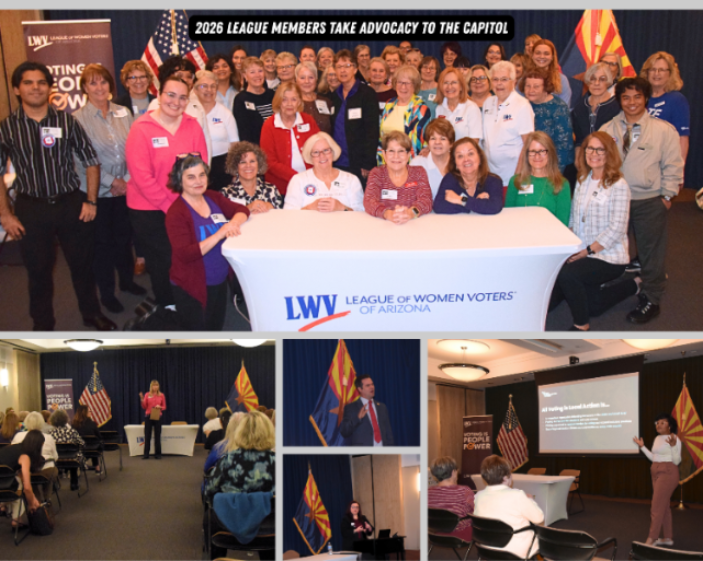
From Learning to Action: League Members Take Advocacy to the Capitol
We had nearly 50 members in attendance, with representation from all local leagues, including local league presidents from four of the five leagues. The strong turnout reflected the commitment of League members from across Arizona to engage directly with the legislative process.
Emily Bridson, LWVAZ President, welcomed the attendees and introduced the speakers. Our speakers included Tearanie Chinn of All Voting is Local, who presented “Democracy is a Practice: Bills, Boards, and Becoming a Poll Monitor,” highlighting practical ways individuals can support and protect democratic processes; Jennifer Loredo and Lourdes Peña, members of Governor Hobbs’ policy staff, who led a robust Q&A session addressing questions about the Governor’s policy priorities and current legislative developments; Senate President Warren Petersen, who spoke about his legislative experience, progress in Arizona, and current policy priorities from the perspective of Senate leadership; and Nicky Indicavitch of Save Our Schools Arizona, who discussed the new citizens’ ballot initiative drafted in partnership with the Arizona Education Association to rein in the ESA voucher program in Arizona.
Although it was crossover week at the legislature, several members still met with their legislators after the morning program and lunch, continuing important conversations about League priorities and key legislation.
This event would not have been possible without the support of our dedicated interns, advocacy consultants, and volunteers, who helped with setup, coordination, and breakdown throughout the day. A special thank you to Cindy Walsh, Emra Muslim, GraceMarie Theesfeld, JL Grossman, Kara Pelletier, Marcia Barry, Patty Raphael, Ricardo Torres, Sarabeth Spencer, and Wendy Parr for their invaluable assistance.
| 
Democracy Needs You: Join the VOTE411 Team for 2026
Arizona Primaries will be held on July 21, 2026
New law moves the Arizona primaries to the second-to-last Tuesday in July. Previously, the primary was held on the first Tuesday in August
Arizona’s 2026 elections will shape our future.
From voting access and public education to water policy and democratic accountability, the decisions made in 2026 will have lasting consequences for communities across the state.
VOTE411 is the League’s trusted, nonpartisan voter guide, a proven, time-honored resource that gives voters clear, accurate, unbiased information straight from the candidates themselves. In a closely divided state like Arizona, strong voter education isn’t optional; it’s essential to ensuring every voter can participate fully and confidently in our democracy.
We need your help to make it happen.
As we gear up for the 2026 elections, we’re recruiting volunteers to:
-
Write unbiased, thoughtful candidate questions - please reply to lwvazadvocacy@gmail.com if you want to help write questions for city council candidates in your city or town, state legislative races (same questions for all candidates, regardless of district or chamber (House/ Senate)
-
Update office position descriptions
-
Analyze state ballot measures
-
Promote VOTE411 through media and outreach
-
Speak at community events
-
Support other critical behind-the-scenes work to ensure our content is complete, accurate, and accessible
Your time and skills directly empower voters—and strengthen democracy statewide.
Take a moment to complete the brief VOTE411 Volunteer Survey and tell us how you’d like to contribute. Vote411 Volunteer Survey
To learn more about what’s involved and when:
Your voice. Your skills. Your impact.
|
League statements and actions
Statement from the League of Women Voters on the passing of Bernard Lafayette
Civil Rights Groups, New Jersey Voters File Motion to Protect Voters’ Privacy
Statement About the President’s Unilateral Military Action in Iran
The US Census Bureau deadline for comments on the 2026 Census Test was this week. The League joined many coalition comments and submitted our own comments to the Bureau.
Read our latest blog about the SAVE act.
Take action and tell your Senators this bill is bad for voters.
Join League in Action here to participate in our call-in days on March 3 and 11, by calling your Senators to urge them to oppose the SAVE America Act.
No Kings Mobilization
LWVUS is joining No Kings as a national partner on Saturday, March 28. Leagues are welcome to lean in locally and participate in activations with partners on the ground in a nonpartisan manner. For Leagues who decide to mobilize for No Kings, please utilize our Protest Safety Guidance and Guidance for Leagues About Nonpartisanship and Partnerships.
| |
QUICK LINKS
League Public Policy Positions
LWVAZ Advocacy and Action Newsletters
Arizona Law: The Legislative Process (a reader-friendly overview)
How a Bill Becomes a Law (a detailed visual explanation of the process from Arizona Agenda)
Guide to Getting Public Records. Another great resource from the Arizona Agenda
RTS Manual
BSI Manual
Arizona Legislative Lingo: Do you need an explainer to understand legislative jargon? Why are there COWs in the state Capitol? Use our handy guide, Arizona Legislative Lingo: Terminology, Definitions, and Abbreviations, to crack the code. | |
CELEBRATE 100+ YEARS OF LEAGUE
LOVE YOUR LEAGUE? DONATE TO YOUR STATE AND LOCAL LEAGUES TO SUPPORT OUR WORK
Donate to the operations fund of the state and local leagues:
Donate to the LWVAZ Education Fund; this donation is tax-deductible, and you can designate your donation for your local league.
| | Copyright © 2024 LEAGUE OF WOMEN VOTERS ARIZONA, All rights reserved. | |